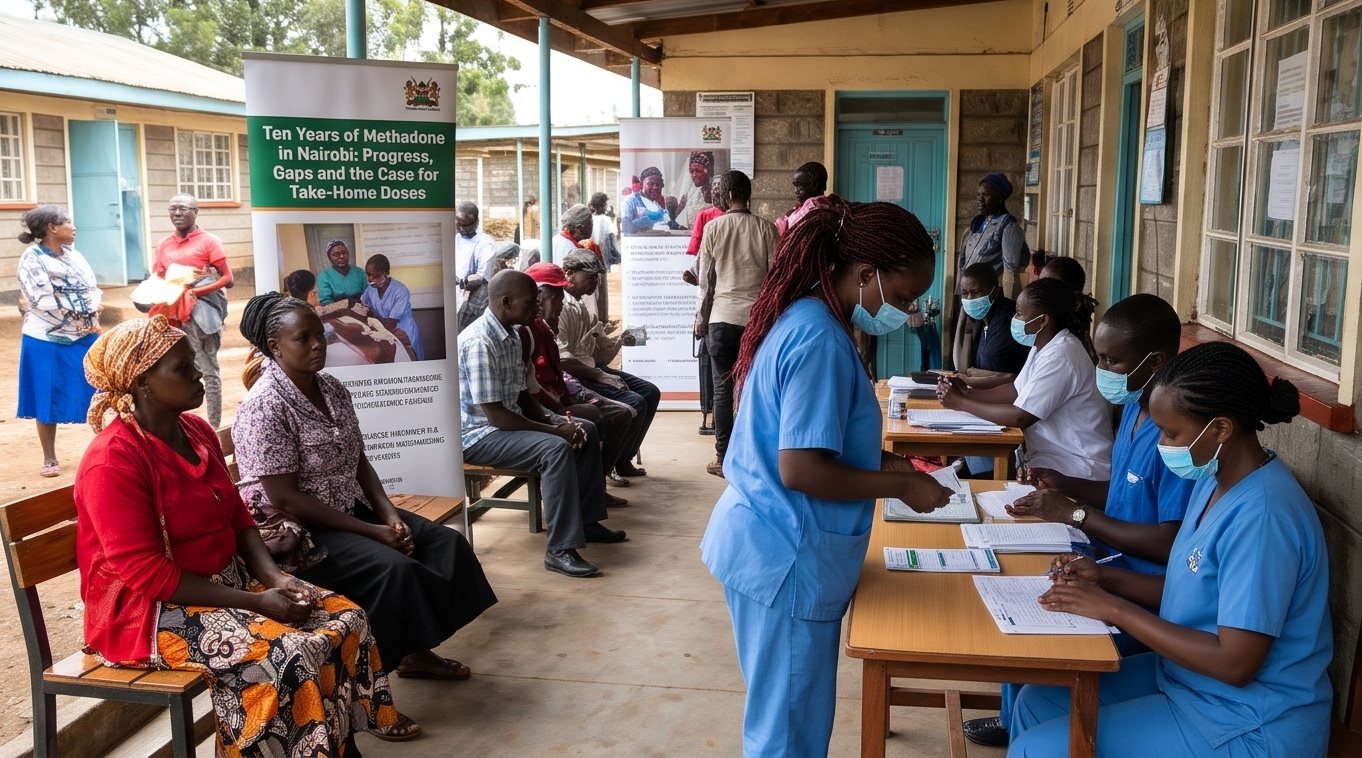
Kenya's methadone programme has helped thousands. Take-home doses and more dispensing points could help thousands more.
Opioid agonist therapy (OAT), most commonly methadone, is one of the best-proven harm reduction interventions in medicine. It reduces opioid use, overdose deaths, HIV and hepatitis C transmission, and involvement with the criminal justice system. Kenya opened its first OAT clinic at Mathari National Teaching and Referral Hospital in December 2014.
A new study published in Frontiers in Public Health in August 2026 by researchers from CIHEB-Kenya, the Ministry of Health, Nairobi City County and partners describes how the Nairobi programme was built and what it has achieved. Its findings offer valuable lessons for the rest of the country.
What the Programme Has Achieved
- 3,354 people started on OAT in Nairobi between 2014 and 2023
- More than 80 health workers trained to deliver OAT
- At enrolment, 98% received urine toxicology screening, 76% HIV testing, 73% hepatitis B and C screening and 100% TB screening
- 87% of clients living with HIV started antiretroviral therapy, with strong viral suppression reported at 12 months
- Kenya's OAT network grew to 10 clinics in four high-burden counties by 2024
- Mobile dispensing vans, introduced during COVID-19, brought methadone closer to people living far from static clinics
These results show that integrating OAT with HIV, hepatitis and TB care works. A single daily visit becomes a gateway to a wide range of health services.
What Is Holding People Back
The study is also frank about the barriers. The biggest is the requirement to collect methadone in person every single day. For people with jobs, family responsibilities, or long and costly commutes, daily attendance is very hard to sustain, and the authors identify it as a major reason people drop out.
Other challenges include:
- Only two static OAT clinics serving Nairobi's estimated 5,024 people who inject drugs across 73 mapped hotspots
- Medication and test-kit shortages, especially in 2022 and 2023, and service disruptions during health worker strikes
- Low enrolment of women, who make up only about 10% of clients
- Heavy reliance on donor funding, which leaves the programme vulnerable to funding changes
"Treatment that people cannot reach is treatment they cannot stay on. Flexibility saves lives."
The Case for Take-Home Doses
Kenya's 2022 guidelines already allow take-home methadone doses in specific situations such as illness, travel, pregnancy, religious fasting and emergencies. According to the study, however, they have not yet been put into practice. Many countries use take-home doses safely for stable clients, with clear eligibility rules, secure storage and regular review.
Implementing what the guidelines already permit would be one of the quickest and cheapest ways to keep more people in treatment.
What HRSK Recommends
- Begin implementing take-home doses for stable clients, as provided in the 2022 guidelines
- Add satellite dispensing points at pharmacies, drop-in centres and prisons, as the study proposes
- Expand mobile dispensing to more counties and underserved areas
- Explore long-acting options such as injectable buprenorphine for people who cannot attend daily
- Design services that welcome women, including childcare-friendly hours and women-only spaces
- Create a dedicated government budget line for OAT so services do not depend on donors
- Develop harm reduction responses for people who use stimulants, a growing need the study highlights
Conclusion
Kenya's methadone programme is a public health success that has reached thousands of people and connected them to life-saving HIV, hepatitis and TB care. The next step is to make treatment fit people's lives. With take-home doses, more dispensing points and sustainable domestic funding, Kenya can turn a decade of progress into lasting impact.
Sources
- Koech E, Welsh C, Karanja M, et al. The pathway to establishing and implementing opioid agonist therapy for people who inject drugs in Nairobi, Kenya. Frontiers in Public Health, 2026
- PLOS Mental Health — Substance use patterns among patients on methadone treatment at a referral hospital in Nairobi
