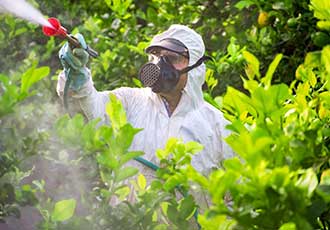
New research confirms banned pesticides in Nyandarua's potatoes. HRSK breaks down what this means for Kenyan consumers and what must urgently change.
A new study from Egerton University has confirmed what food safety advocates have feared for years: Nyandarua County's potato farms — the source of a large proportion of Kenya's potato supply — contain dangerous residues of banned pesticides at levels that exceed international food safety limits. The research, titled "Influence of on-farm pesticide practices and processing methods on pesticide residue levels in potato tubers (Solanum tuberosum L.) in Nyandarua County, Kenya," has been accepted for publication in the prestigious Journal of Food Protection.
The findings demand serious attention. This is not a theoretical risk or a distant concern. Kenya produces approximately 2.5 million tonnes of potatoes annually, with Nyandarua County being one of the primary growing regions. Potatoes are a staple food consumed daily by millions of Kenyan families. When banned, brain-damaging pesticides are found at unsafe levels in this fundamental food crop, it is a public health emergency — and HRSK believes it requires an urgent, evidence-based response.
What the Research Found
Researchers Millicent Kanario, Prof Joseph Wafula, and Dr John Masani from Egerton University's Department of Dairy and Food Science and Technology studied 275 randomly selected potato farmers in Nyandarua County. Their findings reveal a deeply alarming pattern of pesticide misuse:
- 98.8% of farmers used synthetic pesticides regularly — with many applying weekly
- Farmers routinely mixed different chemical types together, creating unpredictable chemical interactions
- Only 12% followed pesticide label instructions — the rest relied on advice from agrochemical retailers or fellow farmers
- Many farmers harvested just three weeks after spraying, far too soon for chemical breakdown
- Two particularly dangerous insecticides — chlorpyrifos and fenitrothion — were detected at levels exceeding international Maximum Residue Limits (MRLs)
The Two Banned Chemicals You Should Know
Chlorpyrifos: A Brain-Damaging Pesticide Still in Kenya's Food Chain
Chlorpyrifos is one of the most widely studied pesticides in the world — and one of the most thoroughly condemned. It is an organophosphate insecticide that disrupts the nervous system by inhibiting acetylcholinesterase, an enzyme essential for nerve function. The evidence against it is overwhelming:
- Neurodevelopmental harm in children: Even low-level prenatal exposure to chlorpyrifos is associated with reduced IQ, attention deficit disorder, autism spectrum disorder, and lasting cognitive impairment. This has been demonstrated in multiple large-scale epidemiological studies.
- Hormone disruption: Chlorpyrifos is an endocrine disruptor, interfering with thyroid function and reproductive hormones.
- Classified as a possible carcinogen by the US Environmental Protection Agency.
The US banned chlorpyrifos from food use in 2021. The European Union banned it in 2020. In Kenya, the Pest Control Products Board (PCPB) initiated a phase-out — with completion due by December 31, 2024. Yet the Egerton University research confirms it remains present in Nyandarua potatoes at levels above the safe limits. This is not just a regulatory failure — it is a preventable public health crisis.
Fenitrothion: Toxic, Proposed for Withdrawal for 25 Years
Fenitrothion is another organophosphate with a deeply troubling profile. It is highly toxic to humans and causes damage to the brain, lungs, liver, and kidneys. Its mechanism of harm is the same as chlorpyrifos — inhibition of cholinesterase — and it has been proposed for withdrawal in Kenya since the year 2000. That is a quarter century of regulatory inaction while a demonstrably dangerous chemical continues to contaminate food consumed by millions of Kenyans.
Acute fenitrothion poisoning produces the characteristic SLUDGE syndrome (salivation, lacrimation, urination, defecation, gastrointestinal cramps, emesis) and can progress to seizures, respiratory failure, and death. Chronic low-level exposure from contaminated food is associated with cumulative neurological damage that may be difficult to attribute directly but is no less real.
Why Are These Chemicals Still Being Used?
The research reveals the human reality behind the statistics: fear drives over-application. Nyandarua's farmers depend on their potato crop for their livelihoods. The popular Shangi variety — which grows quickly and sells well — is highly susceptible to late blight and other pests. For a farmer whose income depends on the harvest, the perceived cost of crop loss far outweighs the perceived cost of a pesticide that they cannot see harming them.
This fear-driven cycle is compounded by several structural failures:
- Agrovets as the primary knowledge source: With only 12% of farmers following label instructions, most rely on agrovet retailers or neighbouring farmers for guidance. Agrochemical retailers have a commercial incentive to sell — not necessarily to advise on the safest or most appropriate products.
- Limited agricultural extension services: Access to trained government agricultural extension officers — who could provide independent, evidence-based advice — has declined significantly over the years as public investment in agricultural extension has fallen.
- Regulatory enforcement gaps: The continued presence of chlorpyrifos above safe limits — after its scheduled phase-out — suggests that enforcement of Kenya's pesticide regulations is inadequate.
- Short harvest intervals: Harvesting just three weeks after spraying, when recommended pre-harvest intervals for some pesticides are significantly longer, ensures that residues have insufficient time to break down to safe levels.
"98.8% of farmers using synthetic pesticides — and only 12% following label instructions. This is not a data point. It is a portrait of a food system under serious stress, and the people bearing the health cost are the consumers who have no idea what they are eating." — Dr. Michael Kariuki, HRSK
Does Cooking Help? What the Research Says
One of the most practical — and sobering — findings of the Egerton University study is its analysis of how different cooking methods affect pesticide residue levels. The researchers tested five common preparation techniques using Shangi potato varieties:
Most to Least Effective for Reducing Pesticide Residues:
- 1. Frying — Most effective overall. Reduced azoxystrobin (a fungicide) by over 92%. High heat and cooking oil appear to degrade multiple pesticide compounds effectively.
- 2. Boiling — Better for water-soluble pesticides, which leach into the cooking water. Reduced azoxystrobin by 10.6% — less effective for fungicides. Discarding the cooking water is important.
- 3. Steaming — Moderate effectiveness. Retains more nutrients than boiling but somewhat less effective at removing pesticide residues.
- 4. Baking — Problematic. Some insecticides remained above safe limits after baking.
- 5. Roasting — Least effective. Over 80% of some pesticide residues remained in roasted potatoes. Roasting Nyandarua potatoes may present the highest risk.
The critical caveat: for chlorpyrifos and fenitrothion specifically, all five cooking methods failed to reduce residues to safe levels. Frying, baking, and roasting all left these dangerous insecticides above their MRLs. This means that for these particular compounds, no cooking method reliably makes contaminated potatoes safe. The solution must be upstream — at the farm level — not in the kitchen.
What This Means for Kenyan Consumers
The practical implications for consumers are significant:
- Washing matters — Thoroughly washing potatoes under running water removes surface residues. Peeling removes further residues concentrated in the skin (though some have penetrated the flesh).
- Boiling and frying are preferable to roasting for reducing pesticide exposure where possible.
- Discarding boiling water removes water-soluble pesticides that leach into it during cooking.
- Diversify your diet — Reducing over-reliance on any single food source reduces cumulative exposure risk.
- However — and this cannot be over-emphasised — these consumer-level measures are insufficient substitutes for farm-level safety. They reduce but do not eliminate risk when prohibited pesticides are present above safe limits.
The Children Are Most at Risk
HRSK wishes to draw particular attention to the risk to children. The neurodevelopmental effects of chlorpyrifos are not evenly distributed across the population — they fall most heavily on the youngest and most vulnerable. Children consume more food relative to their body weight than adults. Their developing brains are uniquely vulnerable to organophosphate toxicity. Prenatal exposure during pregnancy — through a mother eating contaminated food — is associated with measurable IQ deficits and behavioural disorders in the child.
When we discuss pesticide residues in potatoes, we are discussing the cognitive futures of Kenya's children. This must be understood as a child health emergency, not merely a food labelling issue.
What HRSK Is Calling For
HRSK responds to this research with urgency and clarity. We are calling for:
- Immediate enforcement of the chlorpyrifos phase-out that was due December 31, 2024 — including removal from agrovet shelves and seizure of existing stocks
- Accelerated withdrawal of fenitrothion — 25 years of "proposed withdrawal" is unconscionable
- Mandatory pesticide safety training for all farmers before they can purchase Class I and Class II pesticides
- Investment in agricultural extension services to provide farmers with independent, evidence-based pest management advice that reduces over-reliance on pesticides
- Integrated Pest Management (IPM) promotion — equipping Nyandarua farmers with approaches that reduce pesticide dependence while protecting yields
- Regular food safety testing of staple crops with public reporting of results — Kenyan consumers have a right to know what is in their food
- Consumer education on safer food preparation practices that reduce (though cannot eliminate) pesticide exposure
A Note on the Research
HRSK commends the research team at Egerton University — Millicent Kanario, Prof Joseph Wafula, and Dr John Masani — for this important work. The fact that this research exists, that it has been accepted for peer-reviewed publication, and that it is generating public attention is exactly the kind of evidence-based advocacy that drives policy change. HRSK will continue to amplify this research and the urgent call for action it represents.
For our partners in government, in agriculture, and in public health: the evidence is in. The cost of inaction is measured in the cognitive development of Kenya's children, in the chronic illness of farming families, and in the preventable deaths of people who had no idea their food had been poisoned. The time for action is now.
To learn more about HRSK's pesticide harm reduction work, or to partner with us on farmer training and advocacy programmes, contact us at [email protected].
This article draws on original reporting by John Muchangi published in The Star Kenya on 18 May 2025, and the peer-reviewed research by Kanario, Wafula & Masani (Egerton University), accepted for publication in the Journal of Food Protection.
